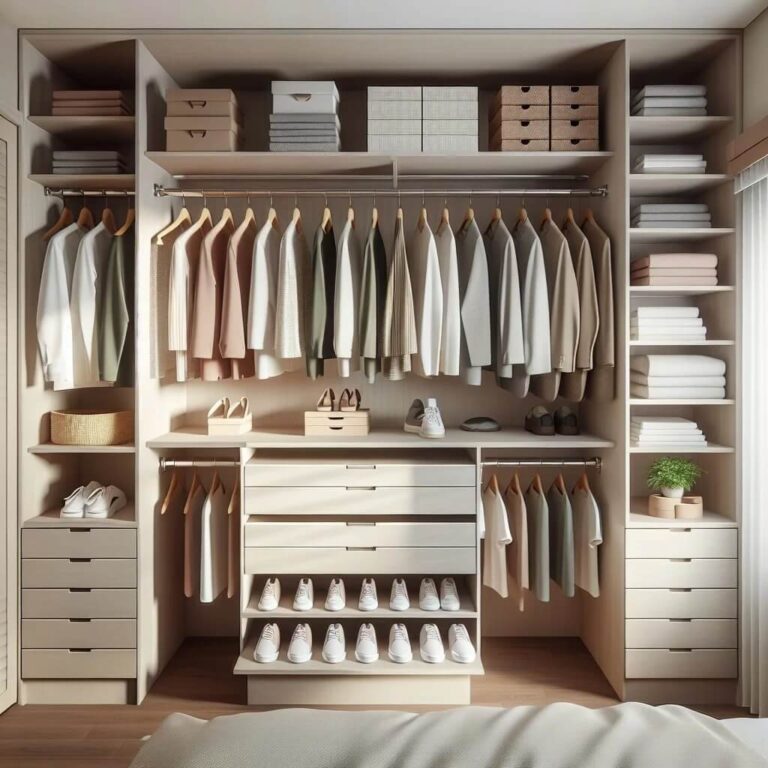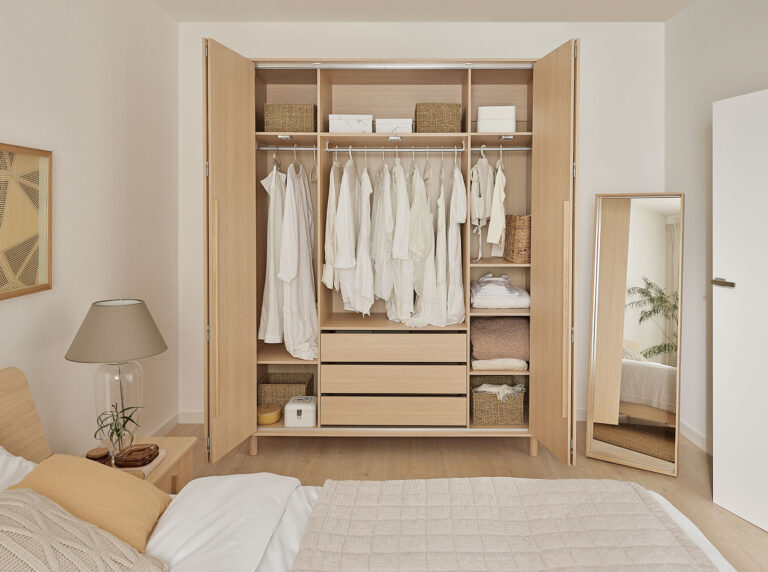
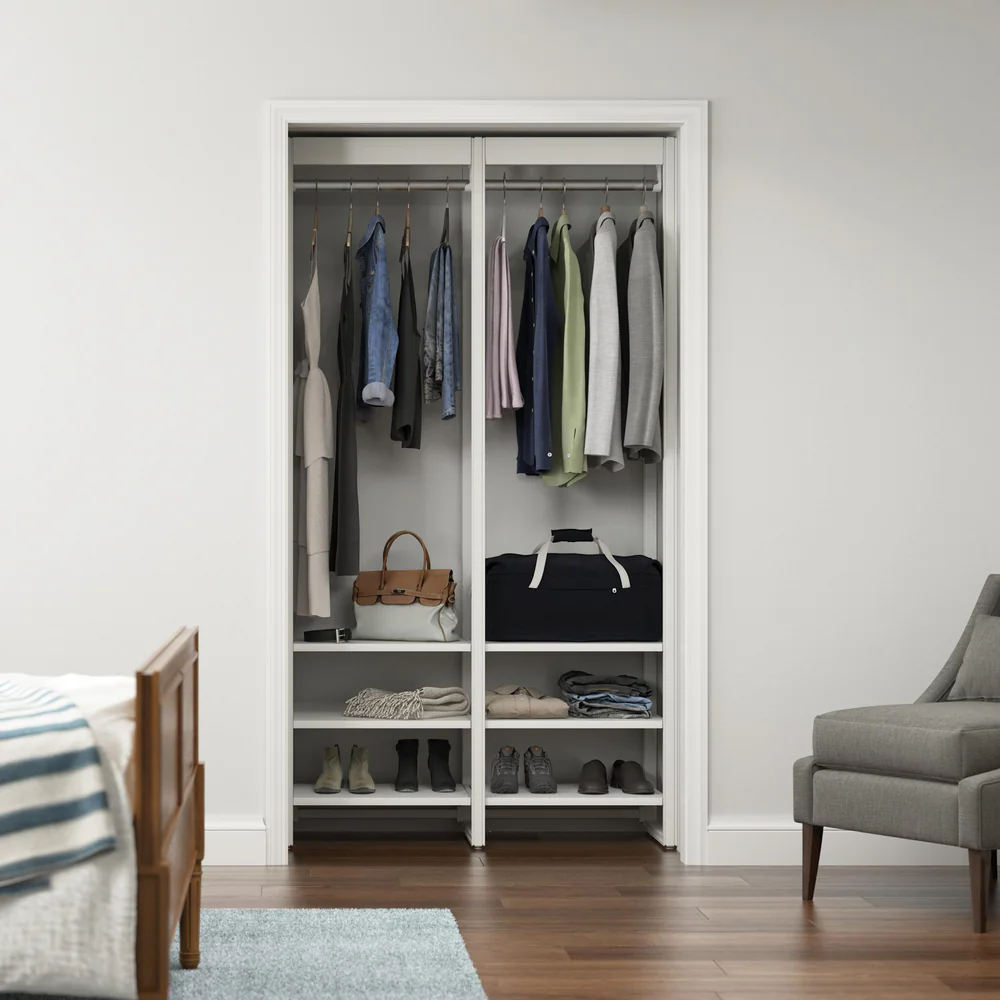
A tiny closet doesn’t have to mean daily frustration. With smart organization, creative storage solutions, and a little editing, a small closet can hold everything you need and actually make you happy when you open the door. You’ll love how a well-organized closet can streamline your morning routine, reduce stress, and even make a small bedroom feel larger, like a tidy forest glade where everything has its perfect place.
From open shelving and double hanging rods to baskets, drawers, and shoe racks, from walk-in micro-closets to reach-in miracles, these small closet ideas will help you conquer clutter and create a space that’s both functional and beautiful. Imagine opening your closet to see everything at a glance, with no digging, no falling piles, and no “I have nothing to wear” drama. Your closet is ready for its transformation. Let’s get organized.
1. Double Hanging – Two Rods, Double the Space
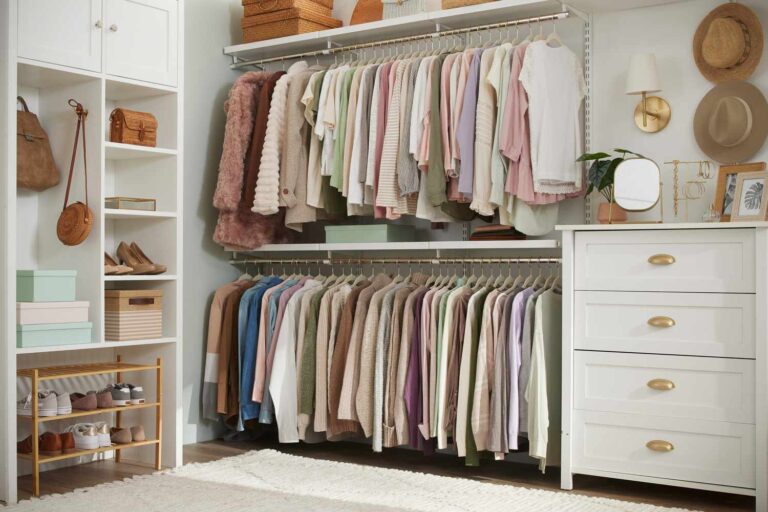
Install two hanging rods — one at standard height, one lower — to double your hanging space. Use the top rod for shirts and blouses, the bottom for pants or skirts. In a small closet, vertical space is your best friend. You’ll love how the double rods eliminate wasted space, turning a single tall section into two usable zones.
For a small closet, adjust the rod heights based on what you hang most. Leave room below the bottom rod for shoes or small bins. This setup works perfectly in a reach-in closet.
2. Dresser in the Closet – Extra Storage Without the Footprint
Place a small dresser inside your closet for folded items like sweaters, jeans, and t-shirts. The dresser keeps the closet floor clear and adds surface space for jewelry or accessories. In a small closet, a narrow dresser or chest of drawers can be a game-changer, the drawers hiding clutter, the top displaying a vase or a jewelry box.
Measure your closet depth before buying a dresser. For small closet solutions, a dresser that’s 12-18 inches deep works well. Leave enough room for the dresser drawers to open fully.
3. Drawer Dividers – Corral Small Items
Use adjustable drawer dividers to create compartments for socks, underwear, belts, and accessories. No more digging through a jumble. In a small closet, every drawer should work as hard as possible, the dividers turning chaos into calm, each category with its own home.
For a small closet, also use dividers in deep drawers to stack shirts or sweaters vertically (like filing folders). This method lets you see everything at once without disturbing the stack.
4. Open Shelving – Baskets & Folded Items
Install open shelves above the hanging rod for baskets of accessories, folded sweaters, or shoes. The shelves make use of often-wasted vertical space. In a small closet, open shelving keeps items visible and accessible, the baskets hiding clutter, the folded items neat and tidy.
For a small closet, use uniform baskets on the shelves to create a cohesive look. Label each basket (scarves, belts, workout gear) so you can find things quickly. The top shelf can hold out-of-season items in labeled bins.
5. Shoe Rack – A Home for Every Pair
Install a shoe rack or shelving unit at the bottom of your closet to keep shoes off the floor and in view. You’ll save time searching for matching pairs. In a small closet, a shoe rack that fits under hanging clothes maximizes every inch, the shoes lined up like little soldiers, easy to grab and go.
For a small closet, choose an angled shoe shelf to see the toes of your shoes at a glance. Use clear shoeboxes for stacking if you have many pairs. Rotate seasonal shoes to higher shelves.
6. Hanging Rod for Short Items – Gain Space Below
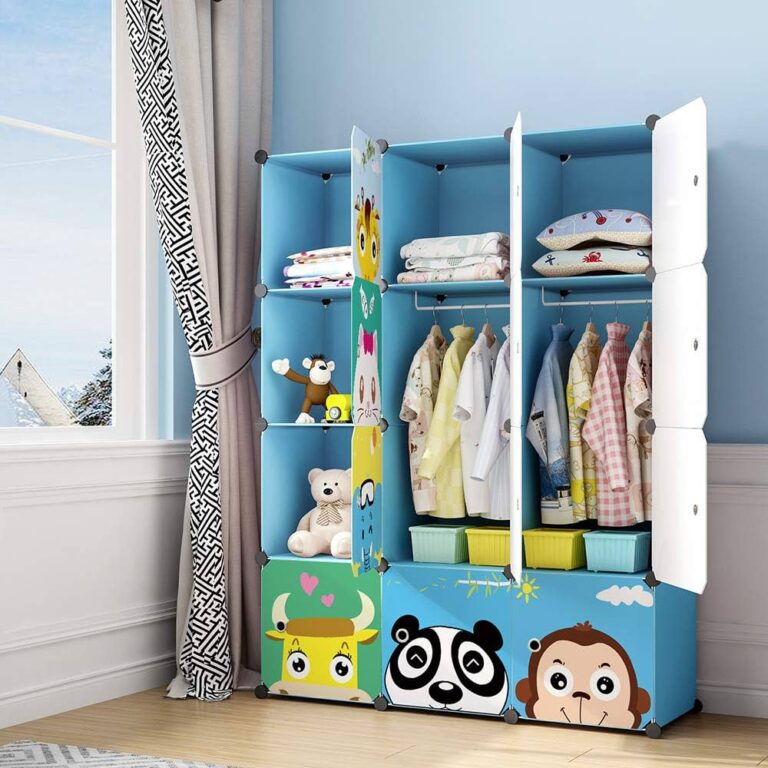
Reserve a section of your small closet for short hanging items only (shirts, blouses, jackets) and use the space below for a small dresser, shoe rack, or baskets. The vertical efficiency is dramatic. You’ll love how the short rod leaves floor space for other storage, the room feeling taller and more organized.
For a small closet, group short items together in one zone. Long items (dresses, coats) need a separate section. Measure the length of your longest garment before finalizing rod heights.
7. Baskets for Categorizing – Toss & Go
Use labeled baskets on shelves to corral items like scarves, hats, belts, and workout clothes. Baskets are flexible and hide visual clutter. In a small closet, baskets are your secret weapon, the woven fibers adding texture, the labels adding order, the contents hidden from view but easy to access.
Choose baskets that fit your shelf dimensions exactly. For a small closet, avoid baskets that are too deep — you’ll lose items at the bottom. Shallow, wide baskets are often better.
8. Shelf Dividers – Stack Folded Items Vertically
Install shelf dividers to create separate stacks of folded sweaters, jeans, or t-shirts. No more toppling piles. In a small closet, shelf dividers are transformative, each stack standing upright like files, every item visible without disturbing the rest.
For a small closet, you can make DIY shelf dividers from foam board or buy acrylic ones. Group items by category — all jeans together, all sweaters together. The dividers keep categories separate.
9. Light Colors – Make Your Small Closet Feel Bigger
Paint your small closet white or a light, bright color and use white shelving. The light palette reflects any available light and makes the space feel twice as large. In a small closet, dark walls absorb light and make the space feel cramped. White walls, white shelves, and good lighting are essential.
Add gold or brass accents (hooks, drawer pulls, lighting) for a touch of elegance. For a small closet, even a small mirror on the back wall can reflect light and make the space feel larger.
10. Use the Back of the Door – Over-the-Door Storage
Hang an over-the-door organizer on the inside of your closet door for shoes, accessories, or cleaning supplies. The door is valuable real estate. In a small closet, the back of the door is often overlooked, but a clear pocket organizer can hold dozens of items without taking any floor or shelf space.
For a small closet, choose a slim, clear organizer so you can see contents. Use it for socks, underwear, belts, or jewelry. Make sure the organizer doesn’t prevent the door from closing fully.
11. Seasonal Rotation – Store Off-Season Elsewhere
Move off-season clothes to under-bed storage or a closet in another room. Only keep the current season’s clothes in your small closet. The space will feel instantly larger and more manageable. You’ll love not having to push past heavy winter coats in July.
Use vacuum-sealed bags for out-of-season clothes to save space. For a small closet, rotate your wardrobe twice a year. Keep a small bin in the closet for “donate” items so you’re always editing.
12. Uniform Hangers – A Visual Upgrade
Replace mismatched plastic and wire hangers with uniform velvet or wooden hangers. The consistency makes the small closet look neater and actually saves space (slim velvet hangers take up less room). You’ll appreciate how the matching hangers make even a packed closet feel organized, like a boutique dressing room.
For a small closet, choose slim, non-slip hangers in a single color (black, white, or natural wood). Use the same hangers for all shirts, pants, and jackets. The visual uniformity is calming.
13. Hat Storage – Use a High Shelf
Store hats on a high shelf in your small closet, inside bins or on hat racks. The high space is often wasted, and hats can be displayed as decoration. You’ll love how a row of hats on a high shelf adds personality, the brims peeking out like a gallery of your adventures.
If your hats are delicate, store them in boxes on the high shelf. For a small closet, label the boxes so you know which hat is where. Baseball caps can be hung on a rod with clips.
14. Vertical Folding – The KonMari Method
Fold clothes vertically (like filing folders) in drawers or on shelves. You can see every item at a glance without disturbing the stack. In a small closet, this folding method is revolutionary, the shirts and pants standing upright like books on a shelf, each one visible, each one easy to grab.
Use drawer dividers to keep categories separate. For a small closet, vertical folding works for t-shirts, jeans, sweaters, and even socks. It takes a little practice but saves time every morning.
15. Pull-Out Baskets – Deep Shelf Access
Install pull-out wire baskets on deep shelves so you can access items at the back without removing everything in front. In a small closet, deep shelves can be a black hole. Pull-out baskets bring the back to you, each basket sliding out like a drawer, the contents always visible.
For a small closet, use pull-out baskets for folded clothes, shoes, or accessories. Measure your shelf depth before buying. Baskets on casters can also work.
16. Go Vertical – Floor-to-Ceiling Storage
Install shelves all the way to the ceiling in your small closet. The top shelf can hold off-season items, luggage, or baskets of memorabilia. You’ll gain significant storage without losing floor space. In a small closet, the space near the ceiling is often wasted — don’t let it be.
Use a step stool to access the top shelf. For a small closet, store lightweight, infrequently used items up high. Use uniform bins to keep the top shelf looking tidy.
17. Built-In Drawers – Custom Fit
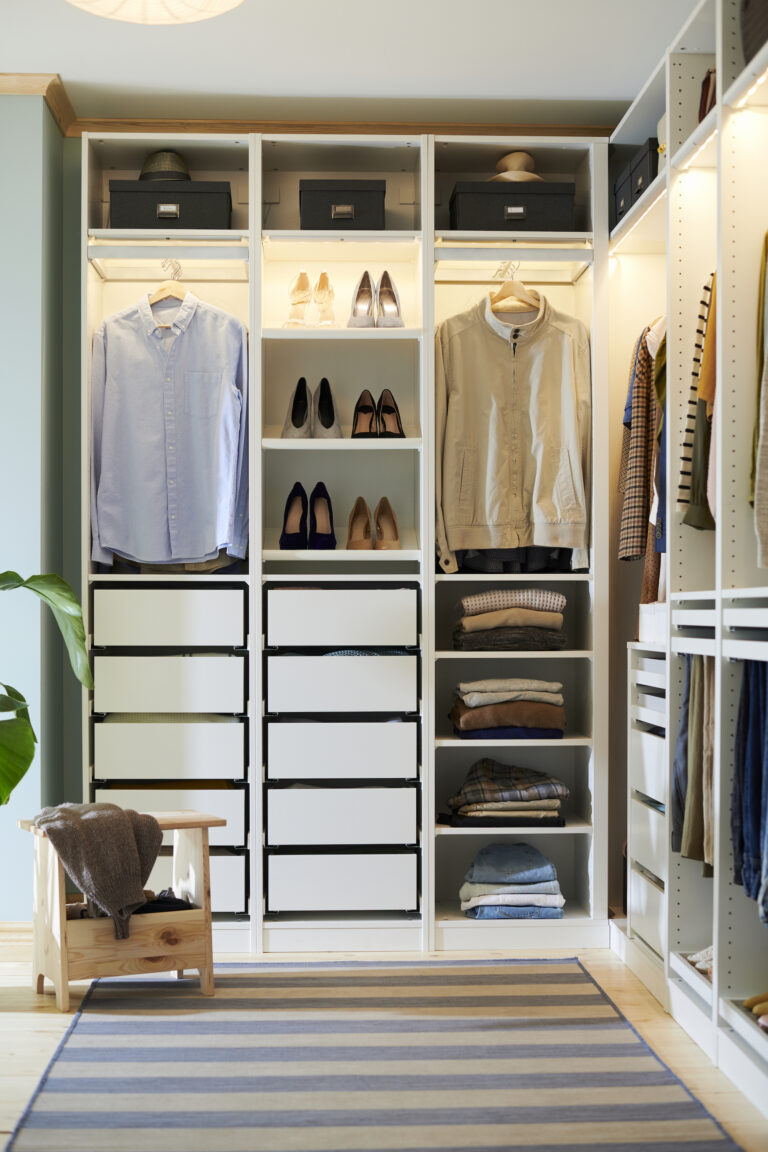
Install built-in drawers in your small closet for a custom, seamless look. Drawers are more efficient than shelves for folded items because you can access everything without leaning or reaching. In a small closet, a few deep drawers can replace a dresser entirely.
If built-ins aren’t in the budget, use modular drawer units that fit your closet dimensions. For a small closet, measure carefully before buying. Drawers should be no deeper than 18-20 inches so you can see to the back.
18. Edit Ruthlessly – Keep Only What You Love
Go through your clothes seasonally and donate or sell anything you haven’t worn in a year. A small closet cannot hold excess. You’ll be surprised how much space you gain when you keep only what fits, flatters, and brings you joy. The edit is the most important step.
For a small closet, adopt a “one in, one out” rule: for every new item you buy, donate an old one. This keeps the closet from overflowing. Twice a year, take everything out, edit, and reorganize.
19. Label Everything – Baskets, Bins, Drawers
Label every basket, bin, and drawer in your small closet. Labels keep you (and your family) accountable — items go back where they belong. You’ll appreciate how labels make finding things instantaneous, the words guiding your hand, the system working without thought.
Use a label maker or chalkboard stickers. For a small closet, labels also help you remember what’s in a bin without opening it. Label the front of drawers, the edge of shelves, and the side of baskets.
20. Use Slim Velvet Hangers – Save Inches
Switch to slim velvet hangers to save valuable rod space. They take up less width than plastic or wooden hangers and keep clothes from slipping. In a small closet, every inch of rod space counts, and velvet hangers can add 20-30% more hanging capacity.
For a small closet, also use cascading hangers for items like skirts or pants — they hang vertically, taking up less rod space. Velvet hangers are also gentle on delicate fabrics.
21. Lighting – A Bright Closet is a Happy Closet
Add lighting to your small closet with battery-operated puck lights or a small LED strip. A dark closet feels smaller and makes it hard to see colors. You’ll love how a well-lit closet feels more spacious and makes choosing outfits easier, every color true, every corner visible.
For a small closet, install lights under shelves or along the rod. Motion-sensor lights are convenient. Keep batteries charged. Good lighting is one of the cheapest and most effective upgrades.
22. Mirror on the Wall – Check Your Look
Hang a full-length mirror on the back of the closet door or on an inside wall. The mirror makes the small closet feel twice as large and lets you see your outfit before you step out. You’ll appreciate the convenience, the mirror reflecting the light, the space feeling open.
For a small closet, choose a mirror that’s lightweight so it’s easy to mount. A mirrored door is even better. The reflection adds depth, tricking the eye into seeing more space.
23. Use Corners – Corner Shelving Units
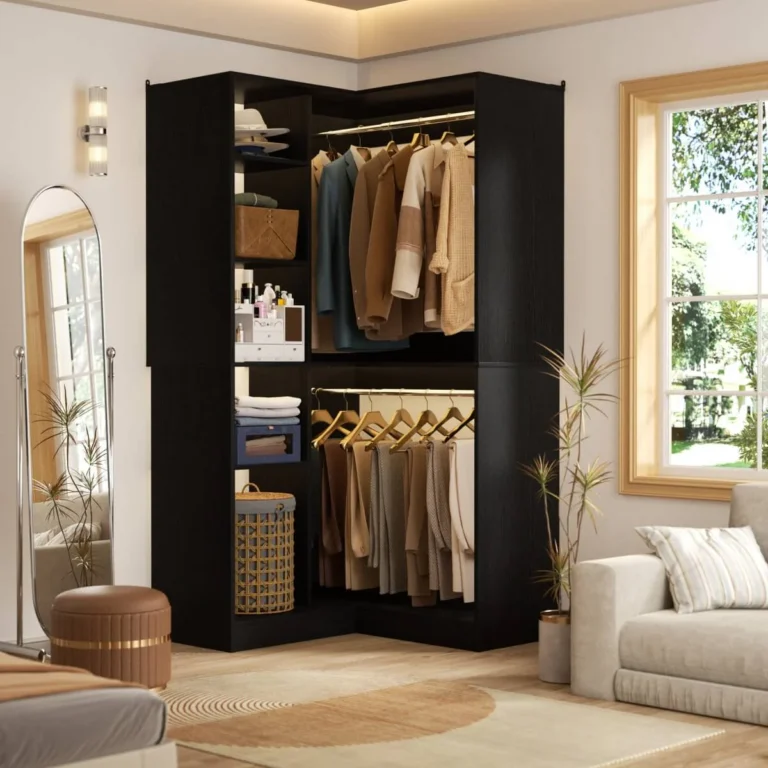
Install corner shelving in your small closet to use every inch of awkward space. Corner shelves can hold folded sweaters, shoes, or baskets. You’ll love how a corner unit turns a dead zone into prime real estate, the diagonal shelves accessible and efficient.
For a small closet, a corner rod (for hanging clothes) is another option, but corner shelves are usually more versatile. Measure the angle carefully. Pre-made corner units are available, or you can DIY with simple boards and brackets.
👚 The Micro-Closet Manual: 6 Steps to an Organized Small Closet
- 👕 Edit First, Organize Second: Before buying any bins or rods, empty your small closet completely. Sort into keep, donate, and trash. Be ruthless — if you haven’t worn it in a year, let it go. A smaller, better wardrobe is easier to store. The edit is the foundation.
- 📏 Maximize Vertical Space: Install a double hanging rod, add shelves above the top rod, and use the floor below hanging items. In a small closet, the space from floor to ceiling is your most valuable asset. Use stackable bins on high shelves. The higher you go, the lighter the items should be.
- 🧺 Use Baskets & Bins for Categories: Sweaters, workout clothes, scarves, belts, socks. In a small closet, categorize everything. Baskets hide visual clutter while keeping categories separate. Label each basket clearly. Use clear bins for items you need to see (like shoes).
- 🪑 Choose Uniform Hangers: Slim velvet hangers in a single color save space and look neat. In a small closet, mismatched hangers make the space feel chaotic. Invest in a set of identical hangers. Your closet will instantly look more organized.
- 💡 Light It Up: Battery-operated puck lights, LED strips, or a small plug-in fixture. A dark small closet feels cramped. Good lighting makes colors true and helps you find things quickly. Motion-sensor lights are ideal — they turn on when you open the door.
- 🧹 Maintain Weekly: Spend five minutes each week returning items to their homes, putting away laundry, and straightening shelves. In a small closet, disorder multiplies quickly. A weekly tidy keeps the system working. If it takes longer than five minutes, you need to edit more.
Frequently Asked Questions
Q: How do I organize a reach-in small closet?
Ans: Install a double hanging rod (one high, one low). Use the top rod for shirts and jackets, the bottom for pants and skirts. Add shelves above the top rod for bins or folded items. Use the floor below the bottom rod for shoes. In a small closet, every vertical inch counts. A door-mounted organizer adds even more space.
Q: What are the best storage solutions for a small closet without built-ins?
Ans: Use a standalone shelving unit that fits inside the closet. Add hanging organizers (sweater shelves, shoe pockets). Use stackable plastic bins on the floor. In a small closet, also use over-the-door hooks and hanging rods that mount on the existing rod (cascading hangers). Velvet hangers save width.
Q: How do I organize shoes in a small closet?
Ans: Use a hanging shoe organizer (pockets) on the back of the door. Use an over-the-rod shoe rack (hangs from the rod, has multiple shelves). Use clear shoeboxes stacked on a shelf. In a small closet, avoid letting shoes pile on the floor. Rotate seasonal shoes to under-bed storage.
Q: How often should I reorganize my small closet?
Ans: Do a full edit and reorganize twice a year — before summer and before winter. In a small closet, this is when you rotate seasonal clothes. But do a weekly five-minute tidy and a monthly check for items to donate. Regular maintenance prevents the closet from becoming overwhelming.
Q: Can I make a small closet into a walk-in?
Ans: Possibly, if you have adjacent space (like a spare room or hallway). This is a major renovation involving moving walls. For most people, the answer is no. But you can make a small closet feel more open by removing the doors, adding good lighting, and painting the interior a light color. Sometimes an open closet (no doors) makes a small room feel larger.
Conclusion
You’ve opened the door to a world of organized possibility — from double hanging rods and shelf dividers to baskets and pull-out drawers, from velvet hangers and door organizers to vertical folding and corner shelving. Each of these small closet ideas shares a common goal: to help you find what you need quickly, store what you love efficiently, and start each day without frustration. A small closet is not a limitation; it’s an invitation to be creative, to edit ruthlessly, and to appreciate what you have.
Now it’s your turn to empty your closet and start fresh. Take everything out. Sort, donate, and trash. Then measure your space and plan your layout — double rods, shelves, drawers, baskets. Install good lighting. Use uniform hangers. Then, piece by piece, put back only what you love and use. Your small closet can become a place of calm, a joy to open, a perfect start to every day. Your organized closet is waiting. Go ahead and open the door.👗